FLY FISHING POLLACK

Pollack (Pollachius pollachius) love warmer waters and are found along the entire coast of Norway. They range from the direct shoreline down to two hundred meters deep. Most people choose to fish Pollack with casting lures or trolling with wobbles. You will often find larger individuals hiding around reefs very close to land.
Skot
|
|
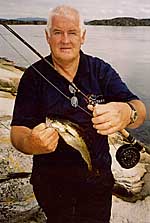
My old man with his first poolack on fly |
|
|
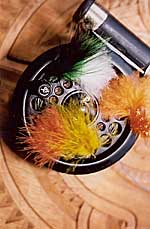
Note the white bellies on these flies |
|
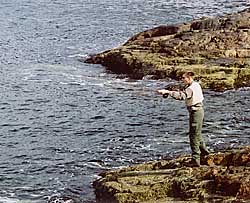
| Ketil Bergh has found the perfect rock ledge |
| |
Unfortunally Pollack is a bi-product of the cod catch here in Norway. Due to their so-called little economic value thousands of tons are thrown over board. On a positive note Norwegians have found a great use for this species, fish cakes. Their white flesh presents a perfect table fish.
After a warm Indian summer I figured that the outer islands was the place to be. We were armed with only two things, sunblock and a fly rod. The trout season was coming to an end and I needed a new thrill so why not try some thing new? I found the perfect combination of current, shallow water and two sheltered islands from the wind.
First and foremost I’m a salmon fisherman and I must admit I had very little knowledge of this species but my success with mackerel on my fly rod earlier in the season gave me plenty of ideas. I had read a story from another journalist and heard that they could put quite a scrap.
The big test
I was in doubt as to what rod weight to use; as Pollack can grow huge I decided to take my all-round rod, which is my small salmon rod. Fly choice was simple. You see Pollack don’t eat flies unlike their fresh water buddies but they are active hunters and as with most predators they strike from the underside so the use of a white flies can simulate the under belly of their pray.
This theory proved to be perfect for the reason I caught a small fish on my first cast and nearly every cast after that. Great fun as that was I wanted some thing bigger so I could prove my point. Using my limited brain mass I sat and thought for a moment and realized that a sinking rig was the only answer. The first cast was a complete success the largest fish I had ever caught hit my fly (the bottom). One fly less in my collection had taught me to bounce the bottom. This worked a treat and I managed to find the fish. Three fish latter I had figured I was the main man of this type of fishing.
As I said earlier these things have a reputation as fighters. This is no lie. Wow do they go. What surprised me the most is when they are close to land they’ll make a run for the nearest ledge. Will trying to find shelter they can run hard and fast, not unlike Moby Dick! This is some thing that will be repeated again and again. So when the fish is close to land don’t relax or they will have the upper hand.
You know that this fish is under rated as a sports fish. With the summer season approaching why not add a new string to your bow and take a day off from the trout and have some fun.
Equipped for the challenge
Use your favourite 6-weight fly rod rigged with sinking line and a minimum leader rated at 5 kilo. The logical choice of fly is white. As I have explained this emulates the underside of baitfish. I have tried all the different kinds of prawn imitations with out a single bite. So I recommend the white option. The one point I have not covered is the salt factor. When undergoing this form of fishing don’t forget to wash your gear. Salt water is a killer. Reels don’t last long with out taking care of them! Skot