This is our future

As we all know kids are the future and I’m of the opinion that they are the generation that will make or break the world we live in. I’m certain that this has been said a thousand times by a thousand different generations. Never has this on-going issue become more apparent that today. Our planet earth now has a population of over six billion, all of which demand their share of a limited resource. The generation that created the world we live in had an almost concrete belief that the fish in the seas were an endless resource and the property of anyone who had a boat. This I witnessed as a small boy.
|
|
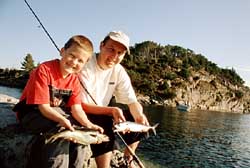
MARK BAKER WITH HIS SON |
|
|
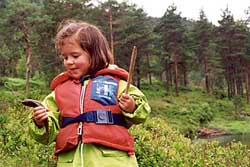
YOU ARE NEVER TO EARLY TO LEARN |
|
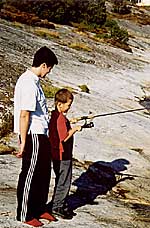
| GRETHE AND STUART FISH IN THE LATE SEASON SUN |
|
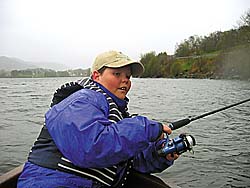
| Here is proof that kids really do enjoy fishing |
My father and I would sail out to sea in his small boat and catch fish almost at will. We would catch snapper and flathead so big that most of the fish was cat food by the end of the summer. This continued until I was about eight years old when suddenly this started to change. Our endless supply of large sport fish became that little more difficult to find and our trips to sea lasted a few hours longer. The locals blamed it on the change of sea currents or a bad year because of the constant northerlies that blew that summer
In hindsight this was far from the truth, but the mumbles of an uneducated generation. As the summer passed more and more old wives tales began to creep into the conversations of the local fishermen.
They answered Mother Nature’s warnings by employing tactics and equipment that only heightened the problem. This was a cycle that continued until all we heard in the local pub was “ In the good old days “. These words were echoed all over the world almost at the same time. It’s sad to say that no one at a local level had the foresight to read the signs. The authorities that said they knew what was best.
I’m now in my thirties. I’ve had a good education and through my work I have seen the results of years of over-fishing and mismanagement. This is very relevant when the questions of our salmon stocks are raised. For the longest period individual rivers throughout Europe began to decline. Total numbers of fish caught each year decreased and as a result local business suffered. This has never been more apparent than here in the west coast of Norway. The town called Voss had a thriving tourist trade. This was due to the fact that the river that ran though the heavily farmed valley
This river was known the world over and as far back as the late 80’s it would cost up to and over 500kr a day. I have a good mate that grew up on this river and almost every trip we have together the conversation ends up at the same topic. What went wrong at Voss? There is a simple answer to this question. Greed! Never have I heard of bag limits or other methods to encourage fishermen to preserve their stocks so as their children can fish this river in the future. An example of this is the saddening statistics from the 2000 season. Just fifty-five salmon were caught. Voss is just one of many examples of mismanagement that has plagued our wild rivers. What saddens me most is I may never get the chance to fish this river or see one of its famed monster salmon! Only time will tell?
Now I’m not saying that there aren’t individuals interested in preserving our rivers but these are not the people we need. At this point I must say the government and its many lobby groups have raised and spent billions of Kroner on this never ending problem It is the “grass rotes” fishermen that can have the greatest impact. By setting an example and showing our children that a freezer full of fish is not the only measure of success. After all we no longer need to fish for our survivoral. It is pure pleasure that we chase when we are on our river.
It is this fact that opened my eyes to the problem. So many people have commented to me that one salmon returned to the river is not going to help. “It’s big business that is the problem and what about those farms “ They are part of the big picture and I agree that these greedy farmers and so-called business men are killing fish with their polluting techniques.
Now you are standing on your favourite river and you hook a salmon after what this fish has over come you decide in you ultimate wisdom to kill your prey .It is at this point you have become a link in the chain of destruction that has only one result, no wild salmon for anyone. I’m certain if this is ever to happen to us (god hope it doesn’t) the first people to be blamed will be the fat cats in their offices but we all must take responsibility for the protection of one of the most beautiful creatures in the sea.
It is here that I will introduce you to the next generation. My little mate Stewart has been raised in the computer generation. Key words in his world are “play station and CD-rom” and all those toys we grown men love to hate. Hours spent playing indoors has meant that his out door education is somewhat lacking. I almost made it a mission to show this young man my Norway and why it so important to learn how to take care of the land around you.
My days in the park services of Australia showed how interested young children are and their willingness to learn about the world around them is inspirational. Stewart is no exception his newfound love of fishing has shown him so much more then any book!
By setting examples our children will learn what it takes to responsibly manage their local fishery. I see young children as the next and most important generation in the constant battle between these two evils, supply and demand. Again I must stress I’m not here to preach or condemn for there are thousands of people fighting for the survival of Atlantic salmon. My point is that we as fishermen can contribute an enormous amount of energy for our own benefit. If our children are taught and learn that we all must take responsibility for our actions. Atlantic salmon has a greater chance of survivoral.