Winter Haddock.

Images of fjords surrounded by white-capped mountains are the stereotypical representation of the Norwegian spring. Yet despite the post card image we sell as a national treasure it is true. Deep in Song Fjord I found the perfect example of this.
|
|
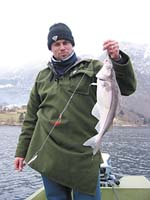
Glen with a great haddock |
|
|
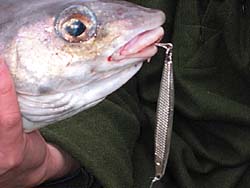
Here you can see how soft a mouth haddock have |
|
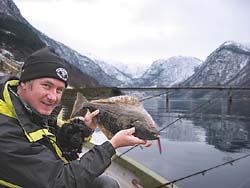
| One of the many "lucky dip fish" in our fjords(photo Glen) |
|
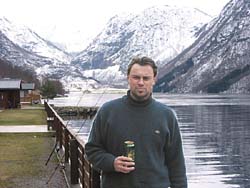
| Rewarded after a hard days fishing |
There is nothing better than a weekend away with your mates and that weekend was no exception. After a long period of office work I was at my wits end and needed nothing more than a few days fishing. Late winter-early spring for me is the toughest time to catch fish. Not only are the trout and salmon sound asleep but also I don’t own a boat. The only answer to this is renting a boat by one of the many breathtaking fjords here on the West Coast.
Finding boat rentals can be difficult but I know of a great place called Nesheim camping. They offer both boat rental and great water front cabins. This camping ground is situated in a village called Bjordal, about two hours drive north of Bergen. This district is famed for its sea fishing and we were there to start our season of with a bang. I had hoped that we would catch some thing new. My aim was nothing short of a haddock. This is a fish I had always wanted to catch before this could happen we had a good bit of reading to complete. Here is the result of our homework and it helped us catch our fish so I hope it can help you.
Habitat
Haddock are found in deep waters (between 60 and 170 meters). It is seldom that you will find them in shallow bays or estuaries. Their favourite habitat is gravel beds, smooth rock, or sand littered with shells. Due to their demands for cold water in summer they will find deeper water so as they can secure consistent water temperatures.
Food
Both juveniles and adults have a similar diet. Which is basically all slow moving Invertebrates. Small crabs, sea cucumbers, sea worms, starfish and the odd squid. Small fish such as herring or eels are seldom part of their diet. As a conclusion the best baits are crabmeat and muscles.
Techniques
The standard 8-foot boat road will do the trick but some thing worth remembering is that this species has a very soft mouth and tends to nibble its bait. We were using eight kilo monofilament but don’t worry if you wish to try something a little heavier as with all forms of sea fishing it’s a mixed bag. Some days you can catch so many different species that heavier line is your insurance. The kind of rig is similar to that of cod rig the only difference is instead of rubber jigs. We tried a combination of flies, bait and jigs. This was for a reason. We simply wanted to catch any thing. A lot like an each way bet on the horses. The technically correct way is a bottom lead with droppers of baits on 6/0 hooks. They say it’s handy to tie a dash of yellow wool to the shank of the hook. I can’t really say if this is worth doing for the simple fact we didn’t bother. The most important tip I can give Haddock fishermen is to be gentle. As you can see they have incredibly soft mouths and hooks can be ripped out if you don’t take care of what you are doing. The most important thing is not to pump your rod but wind with a steady rhythm. This will guaranty a haddock for the table.
With all of this information there should be no reason why you don’t catch a haddock the next time you are out in a boat. There is one import thing I must mention before you start fishing. Norway’s government has started working on a plan to introduce size limits for many of the sea species. The photo of the halibut is a classic example of sea fishing. That was an unexpected fish but the Size Limit in Norway is 60cm and this fish fell short of the legal mark. As with many fishermen here and over seas this information is almost impossible to obtain. So over the next few weeks I will dig out all the bag/size limits here and print them so as we all know that we are doing the correct thing.