Seatrout tactics

You have read my antics on the hunt for seatrout so by now you must be ready to sink your teeth into some serious seatrout fishing. Over the next few paragraphs I will give all my secrets and tips, so as you to can land a monster!
photo/text skot
|
|
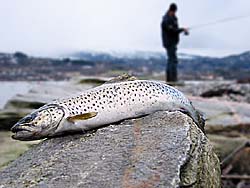
There is nothing better than the first fish of the season |
|
|
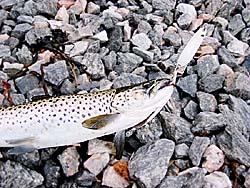
One of the best seatrout lures, Activ Fritid's spoon |
|
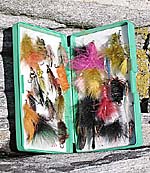
| Every fly kit should have this range of colours |
|
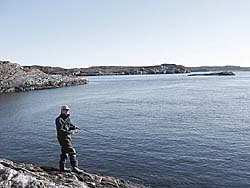
| Shallow sandy beaches are often the best places to find seatrout |
Tackle is your starting point. It’s no use using a canon to shot a fly! Yes? Here is a list of the correct rod sizes for both fly and lure:
· 9-10 foot 7 or 8-weight fly rod
· 11 to 15 foot casting “seatrout” rod
· Never use boat rods
I tend to use one rod only for my seatrout and have set it up in such a way it is always ready. For my fly days I use only an eight weight that is a little stiff. I have always liked the Berkly Safari Series. This can counteract even the biggest fish. My lure rod is an 11 foot casting rod which can throw a lure almost a mile, well a long way anyway. Here in Norway I have tested many models and have found my favourite to be the Vangen Highlander. This particular rod is rated for casting lures from 8 to 40 grams.
LURES
Lures come in all shapes and sizes and I can say that I’ve tried everyone on the market here in Bergen and two or three stand out. Møresild's ranges of herring imitations are some of the best. In particular their new white and green 10 gram “sild” is a winner in my book. Along with that there is the range of Active Fritid seatrout lures. They are designed to imitate one of the many baitfishes that are preyed on by sea-trout. Choosing the correct colour is so simple I use bright lures in the worst of the weather and white for the still days. At night black is the only colour that will work. There is no need to own more than three colours. I’ve caught so many trout with only three different colour patterns. Why carry boxes full of unneeded and unwanted lures.
FLIES
Again as with lures there are so many different types of flies that knowing where to start is not easy. If I’m fishing in the salt water I favour flies with great action and colour. For example the General practitioner is always worth a shot. Over the next few weeks I will pull out my fly box and write a full description of the ten best flies we use here in Norway. I have a general rule that I follow with out fail. White flies on sunny days, black woolly patterns for my night work and red flowing patterns for the not so sunny days. As with all sea-trout fishing I’m not that happy if it’s sunny. If I am so unfortunate to have sunny conditions then I go home and enjoy the sun.
WHERE & WHEN
Here in Norway we catch seatrout the entire year but without doubt there is only one season that counts and that’s spring. The period when the first snow has started to melt until late May are red-hot weeks. I tend to start a little early so as I can find the best bays. This enables me to check the water temperatures. So its early spring and you wish to find the perfect location to begin your season. Well it is so simple just look in your local district and find where the trout lakes run to the sea and bingo any small bay in the neighbourhood will do. If you are so lucky to find a sand filled bay that has good cover, then the high tide that coordinates with the setting sun are you best prospect to catch a fish. It is so important not to fish in the mid-day sun. I have learnt over the past few years that it’s a complete waist of time. Yes! you will see plenty of fish but the problem is they can see you.
TEMPERATURE
Two of the most important factors to be learnt are salinity and temperature. If you learn to master these environmental factors then for the rest of your life you will always catch fish
Sea-trout do not like the combination of very cold and very salt water. Under such circumstances they are having a hard time keeping their internal salt balance intact. Thus when the water gets very cold, sea-trout migrate into warmer water - if possible - or search out more brackish water.
These migrations are of course of paramount importance to the fisherman looking for sea-trout. Taking advantage of this knowledge you can search for seatrout in brackish and secluded bays when winter rules. In the opposite end of the spectrum, you can follow summer seatrout when they migrate out into the open and salty sea to feed.
During the hot summertime, the shallow coastal waters will usually be too warm for the seatrout to feel comfortable. In general trout does not favour temperatures greater than 15 degrees Celsius. So they usually opt for deeper and colder water. At least during daylight. They are well aware of the abundance of food still found close to shore. But they wait until the sun sets before they enter shallow waters to feed.
I hope that these pointers will help you with your spring seatrout fishing As long a you remember to follow overcast conditions and take into account that temperature is the most important factor for success. Skot