Sea-trout in the dead of night.

My first meeting with a Norwegian fisherman was one of the most interesting days of my life. Fortune smiled on me that day, I latter learnt that he’s a writer with one of Norway’s many magazines. I could not believe my luck to be living next to another journalist. After a few beers and the obligatory chit chat about our favourite forms of fishing he invited me along with a few of his mates to try our hand at night fishing for sea-trout.
Skot text/photo

|
|
Paul with a sexy kilo fish, Note the activ fritid lure still in its mouth. |
|
|
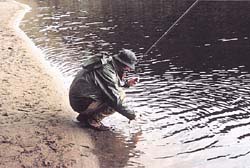
A prime example of day light sea-trout, often smaller |
|
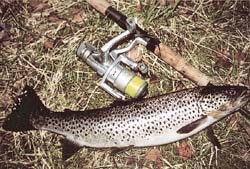
| 0.25 mm line is all that is needed to land these fish |
|
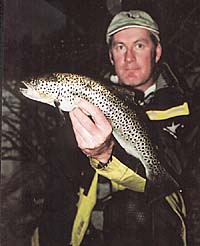
| Yet an other example of night time fishing! |
Night fishing not only presents a challenge but can be one of the most frustrating past times known to man. Whether it’s rivers, lakes or fjord you to try and “bag” a fish it’s all the same, bloody hard work. There are so many factors that are working against you. Not only the lack of light is a hindrance but also your senses are over loaded with new sounds and smells. Knots that never appear during the day find their way into your reel.
EQUIPMENT
Before undertaking night fishing there are some important facts that can’t be over looked. There is one thing that both fly fishermen and lure casters should take note of. Black is your best friend. Tube flies with black bushy shapes or skating cadies are the only flies I use. We lure casters should use black surface wobblers or sea-trout spoons. There is one lure that stands out above the rest. The Activ Fritid ranges of sea-trout spoons are the only one I use. This is because it’s a killer and to this date has never let me down.
WHERE
So you have a comprehensive range of the different sizes and shapes and you are ready to find the perfect hunting ground. It is here that hard work begins. As with day light fishing knowing the layout of the land is so important. While engaged in the constant hunt for the allusive night creatures of Norway what was a simple stone to cast from can become perilous in the emptiness of night. There is nothing better than research.
I love nothing more than shallow sandy beaches. There are a few good reasons for this. Not only is the water warmer during the spring but a large number smaller baitfish come out after dark. The trout are sheltered by the darkness. They can hunt with a sense of security that is ill afforded in the day light hours. Don’t forget to co-ordinate the in coming tide with the setting sun. This will certainly heighten your chances ten-fold.
LIGHTS CAMERA ACTION
Let me tell you about our most resent trip. The Fishbooking crew assembled for our first night session of the season. The good news was passed to the boys that my “girlie” and I had already caught a good fish the night before. I had forgotten my camera due to the fact I had the worlds worst hang over so I had no choice but to take the ”pro’s” along and do the job properly. Early afternoon we found the perfect inland beach. Taking the time to rig our rods and scout the terrain assured us that that night would be the one. By sun set we had a hand full of smaller fish. That was an example of my point. The particular beach we fished is famed for its sea-trout and the many small fish were expected. By nine o’clock it was pitch black and time to catch the big one.
We all agreed that a short walk down the road to the other end of the beach where the tide had started to rise would be the best place. We knew that a small stretch of the beach had both a good current and a deep hole that the fish often hid within. Paul had his rod ready before I could blink and his second cast was so well placed that no fish could say no to his gorgeous spoon. As with all night fishing playing your fish is never easy. Knowing where your fish is turning or jumping is always impossible to predict. This fact did not top Paul from doing what he does best. With in a short time he succeed in making me look bad. The noise and laughter certainly sent the other fish running but we didn’t care. We were but moments away from victory. Landing a whopper at night is always a panic stricken activity but I did my job. All we had left was the photo session and fifty cigarettes.
Important facts
During the spring months this is an activity that is undertaken by thousands of fishermen throughout the land. Yet there are a few rules that must be followed;
1. Never fish with in the 100-meter forbidden zones that are marked around all river mouths here in Norway.
2. Contact your local fishing agency or government ranger and ask when the season opens (this varies from county to county)
3. Respect the minimum length of 35 cm.
If you are in Norway before the river systems are open then find a river that is famed for its sea-trout. If you explore the district and find the best shallow beaches or currents then you are bound to catch a fish.
Here are the 5 best sea-trout rivers in Norway:
River Total (kg) Average
Driva catchments 5534 1.8 kg
Vefsn’s catchments 3933 0.9kg
Surna/ Rina 2985 1.0kg
Fusta’s catchments 2318 1.0kg
Beiar’s catchments 2313 0.8kg
It must be noted that Tana’s catchment figures are not yet printed but it must be in the top three rivers in Norway.
Skot