A benefit to the farming problem!

I’ve written about the wild rainbow trout living in lakes such as Skogseidsvannet but there is a dark side to the rainbow issue. Despite this our crew here at fishbooking have found benefits that can’t go unsaid.
|
|
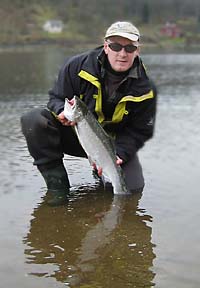
The first of many escaped fish caught on the day |
|
|
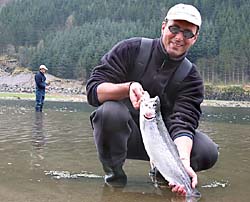
Paul with a result while Glenn is still trying to catch his first |
|
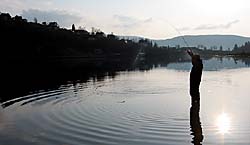
| The last fish for the day |
|
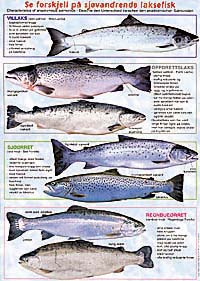
| Here is an easy guide to see the difference between farmed and wild fish |
Since the mid 80’s Norway has taken to fish farming with vigour over the entire coast farms have popped up. In its early days laws were broken and problems began to cloud the entire industry. Large numbers of fish had escaped and fled into our fjords. This was seen as a destructive pattern. Yet as with every thing in my world there is a positive side to this story.
We sports fishermen have everything to benefit from this. These escaped fish are an easy source of food. I have fished countless fjords and rivers over the last seven years and on the odd day rainbow/salmon have been the only fish I’ve caught. The particular day we caught these fish has one hell of a story behind it.
Circus “La Bergen”
There is a company called Leroy and they have a processing plant that is located on the fjord. It is here they have holding tanks for live fish. Unfortunally someone in his or her ultimate wisdom had plans to set these fish free. This led to a carnival here in town. The government gave orders for the fish to be removed. Never had I seen so many people fishing on the same day. The local TV stations were out to cover the story it was a bloody circus.
Men women and children were out in force with every kind of rod produced in Norway. The local tackle shops sold lures and hooks by the bag load. Basically the biggest fishing festival Bergen has ever seen. No sooner had the fish been sighted than they vanished. Yet this smart cookie knew come spring they would reappear. I had an idea were it was they would end up.
You see despite the fact these fish were raised in farms they have the same habits as their wild counter parts: the need for warmer spring waters, rich nutrient feeding grounds and a river to breed in. This combination can be found on the inland island called Østerøy. Here was an opportunity our team could not resist. So, early in the season there we were armed with surface spoons herring imitations and wobblers ready to do the world a favour!
Farmed fish that have been in the fjords for some time can grow to be strong fighters but as a rule they are not the meanest fish in the world. When it comes down to it, this form of fishing needs no sporting element: for example “catch and release” or light tackle. Despite that I always try to use these days as training both with my equipment choice and casting technique.
Facts
As an interesting reference point I’ve found the figures the represent the total percent of farmed fish caught each year from 89 until 98. For example in ‘91 ten percent of all salmon/rainbow trout caught in the fjords had escaped from farms.
Relative percent of farmed salmon/rainbow trout caught in fjord and rivers in Norway from 1989 until 1998.
Year Coast Fjords Sports fish rivers Natural- rivers
% % % %
1989 45 14 7 35
1990 48 15 7 34
1991 49 10 5 24
1992 44 21 5 26
1993 47 20 4 22
1994 36 19 4 22
1995 39 17 4 29
1996 47 16 7 31
1997 47 32 9 29
1998 43 32 9 22
Source: Norsk institutt for naturforskning (Oppdragsmelding 603-1999).
We sports fishermen need not interpret these figures as the death knoll for wild salmon. It is clear that the percent is falling each year but we must expect that our need for fish farms will create these figures. Here in Norway every possible precaution is taken to reduce this problem. This should not stop us from having a day out in the sun with the possibility of catching a great eating fish. This is a topic that has caused much debate in Northern Europe but the average fisherman is almost powerless to do anything about this. The best advice I can give is to take note of the chart and kill every “domestic” fish you catch.
Skot.