Yellow fin tuna, yes please!.

The sea fishing season has started and it’s time that fresh water fishermen find there way to the coast. As a natural progression our choice of fishing follows the seasonal weather changes. Our lakes temperatures are reducing and the trout species are entering their breeding phase. While pondering over the season that has passed one of my greatest ocean adventures suddenly came as a vision. Landing my first yellowfin tuna!
Text/photo's skot
|
|
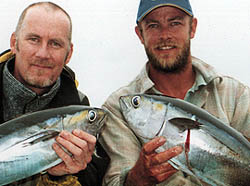
The captain and I are proud to show our catch |
|
|
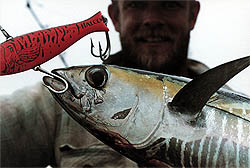
Wobblers such as these work a treat |
|
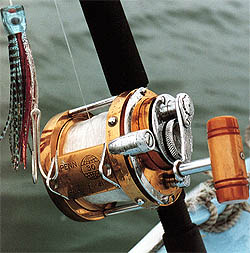
| Equipment such as this is supplied with you charter |
|
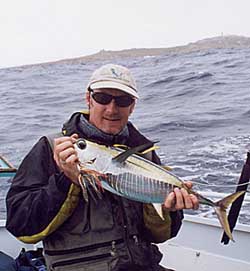
| What a classic fish, one i will never forget. |
Thunnus albacares, Commonly known as Yellow fin tuna can grow up to and beyond 150 kilograms yet the average caught in Australia is between 15 and 50 kilos. Yellowfin tuna are an oceanic migrator known to work close to the shore in waters less than 50m deep. They also can be found off rocky headlands. Fortunately Australia is not the only country that this prized species. They are found in countries such as USA, UK, Mauritius, Micronesia, Solomon Islands, Trinidad Tobago, South Africa, Sierra Leone, St. Helena, Papua New Guinea, New Zealand, Mauritania and Djibouti
Tuna are famed for their muscle breaking fight and Bermagui (south coast News South Wales) is one of the great destinations for game fishermen. Fishing greats such as Zane Grey spent countless months fishing in the district. In fact the local museum is filled with interesting facts and stories of the great “western” novelist. His exploits inspired me to catch a wild fish.
Finding a boat turned out to be a challenge. Unfortunally an international deep-sea tournament was in full swing, which left very few charters available. I was fortunate a local tour operator was so kind as to pull a few strings. All to early the following morning I was booked on a practical boat called Point Five.
My guide explained that the sudden dropping of the sea floor that is called the “continental shelf” provides a rich source of baitfish for the oceanic predators such as tuna and marlin. Our approach was to trawl large rattling lures that were designed to imitate an injured fish. Despite the choppy ocean conditions we managed to find the odd school. This form of fishing is a real waiting game. Long intervals of boredom are interrupted by chaos.
Yellowfin have a tendency to dive in deep circular runs so be prepared for so fun if you are fortunate to have the chance travel to warmer water. Game fishing in new countries has an advantage, by renting a charter crew for the day all the worry and stress about the how, when and where is avoided. The captain and his crew do everything in their power to find the schools of fish. I have heard people claim that it is beyond the average budget. This is quite the opposite I have paid as little as 40 £ a day
Something that must not go unsaid is that with out doubt these are the best fish in the sea to eat. The worlds demand for tinned tuna has ruined the reputation of what I consider one of life’s true luxuries. Next time you are in your local fishmonger ask if he has some tuna stakes and try this salsa dish that our chief Ståle highly recommends.
YELLOW FIN TUNA WITH A NUT CRUST AND MANGO SALSA
•INGREDIENTS: SALSA:
•1 large red bell peppers, cut into 1/4-inch pieces
•2 mangos, peeled, pitted, cut into 1/4-inch pieces
•1/2 cup orange juice
•1 cup finely chopped fresh cilantro
•1/2 small red onion, finely diced
•2 tablespoons fresh lime juice
•1 tablespoon olive oil
•1 tablespoon oriental sesame oil
•1 tablespoon rice wine vinegar
•1 teaspoon of finely chopped garlic
•1Jalapeno pepper, seeded and diced fine
FISH:
•1/2 cup all purpose flour
•2 large eggs
•3 cups pistacchio nuts or macadamia nuts (ground fine in a food processor)
•6 6-ounce or 12 3-ounce yellow fin or albacore steaks
•4 tablespoons olive oil
PREPARATION:
•Combine first 10 ingredients in large bowl and stir to blend. Season the salsa to taste with salt and pepper. (Can be prepared 1 day ahead. Cover and refrigerate. Bring to room temperature before serving.)
•Preheat oven to 350°F then Place flour in shallow bowl. Whisk eggs in small bowl to blend. Finely grind nuts in processor. Transfer nuts to another bowl. Sprinkle fish with salt and pepper. Coat the fish with flour. Dip fish into eggs, then macadamia nuts, coating completely. Heat 2 tablespoons oil in each of 2 heavy large skillets over medium heat. Place 3 fillets in each skillet; cook until golden brown, about 2 minutes per side. Transfer fillets to large baking sheet.
•Bake fish until just opaque in center, about 7 minutes. Divide salsa among 6 plates. Top with fish and serve. 6 Servings